
What's she thinking?
A decision-making guide for POV nerds


During the Q&A portion of fiction-focused book events, more often than not, a well-meaning audience member will query, “Where do you get your ideas from?” In some cases the question is a thinly veiled attempt to find out the degree of autobiography in a novel, but I think mostly folks are legit at a loss to understand how an idea becomes a story.
Writers have all sorts of answers. Some are plot-centric: I wondered what might happen if Germany won World War II? Some are suspense-driven: What if a woman finds out that her husband is leading a double-life, and has a second family? Sometimes a voice will arrive. A voice steeped in lyrical, quirky, “burnt tongue.” Occasionally, a dream will inspire a project. Or a childhood memory that keeps surfacing.
In other words, the sky is indeed the limit when it comes to inspiration.
But between idea and execution lie hundreds of decisions. The elements of which (setting, plot, character, timeline and so forth) must come together to engage and lead the reader away from their reality into the author’s made up world.
As a writer drawn to character-driven novels and stories, for me the decisions that torment intrigue me the most are those cemented in POV.
Whose story is it? How much should a non-character (otherwise known as an omniscient narrator) weigh in? First, second, third person? And if third person, how close, how many, in what order? How or when to transition from one POV to another? Who in the cast does NOT get a POV? And why not? What does it buy the narrative to purposely withhold interior perspective on a given character? Aren’t these fun questions?
On a recent road trip, my husband and I worked our way through an audiobook version of The Road to Tender Hearts. I fell in love with the whimsical (and darkly funny) tone of the novel. The author, Annie Hartnett, adopted a flexible POV strategy right out of the gate, moving facilely from her main character to other characters (even, briefly, a cat, a ballcap, and other non-sentient players).
Some might chastise the in-and-out of so many perspectives as head-hopping, but in the case of this novel, Hartnett sets up the narrator as a sort of orchestral conductor who immediately establishes the blend of realism and fantasy that propels the story forward.
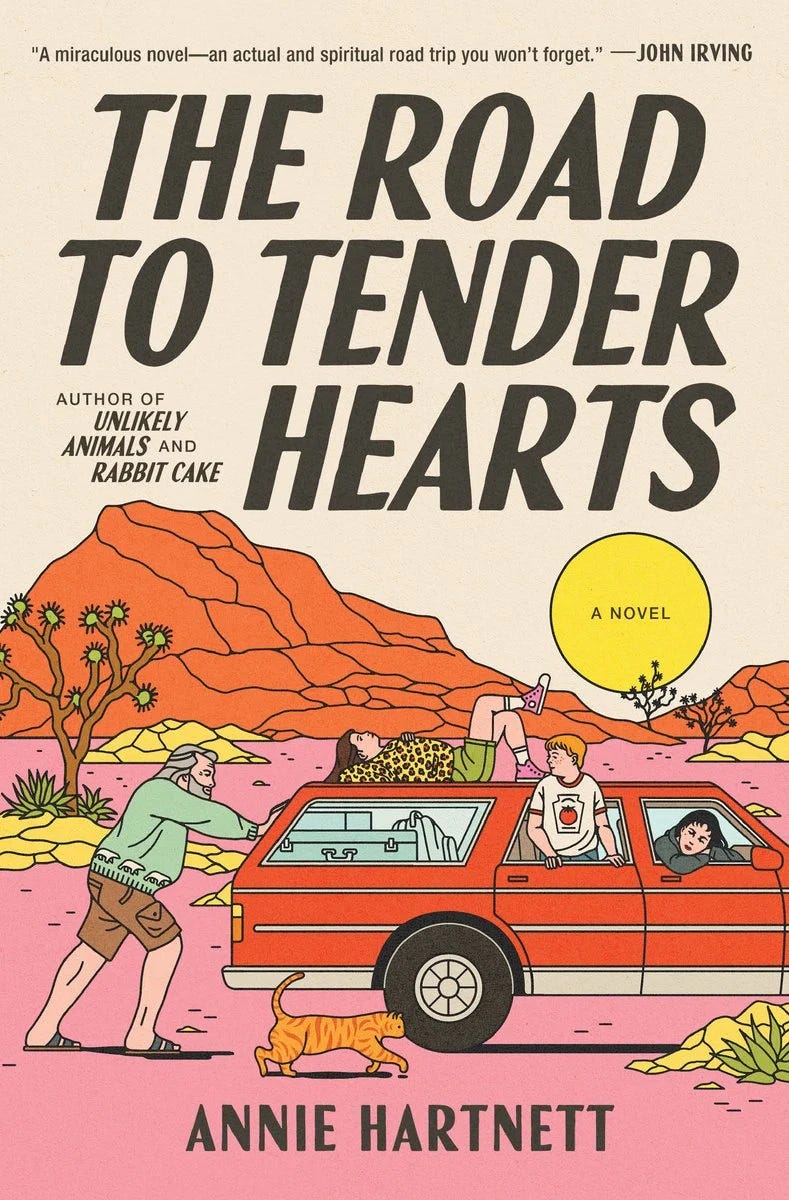
But it’s not just about intriguing voice. Books succeed when they immerse the reader in the action of a story while at the same time establishing narrative authority. And we know that attention these days is at a premium, so all of this needs to happen quickly. Tender Hearts enrolls the reader immediately with the introduction of a cat that can predict imminent death. If you, like me, are a total craft nerd, I highly recommend this novel as inspiration.
In service to creating a starting gate, here is a short list of POV decision-making considerations for your next fiction project.
Do you want to include an omniscient narrator? If so, decide whether they will know the outcome of the story from the get-go, or will they have the same limited knowledge of the arc as the reader and/or the other characters
Does the story’s design depend on a range of perspectives, or a single POV?
Will the story evolve as raw experience, or will it be told from a reflective perspective (in other words, past or present tense, or, in rare cases, both?)
Who in the cast of characters should not get a POV? Are you writing a thriller, perhaps, and want to incorporate an element of shock or surprise by avoiding the perspective of your villain?
These are starter questions, but I have more up my sleeve! I’ll be teaching an online class on POV on May 17, link to info available soon, so watch this space.
Meanwhile, what pressing POV questions do you have? Feel free to AMA in the comments!
Your SS could have arrived at a more opportune moment! I am immersed in CeCe Lyra's Interiority and Psychological Acuity webinar, as recommended by YOU (thank you!), and I have answered some but not all of your sample questions. Top of 'em all, I want to provide multiple POVs without angering the dreaded "head-hopping" police, so The Road to Tender Hearts will be on my list. right after I stroll through "Heist Society" and "Entitlement," as rec'ed by Ms. Lyra. xxxx